“She never smiled”
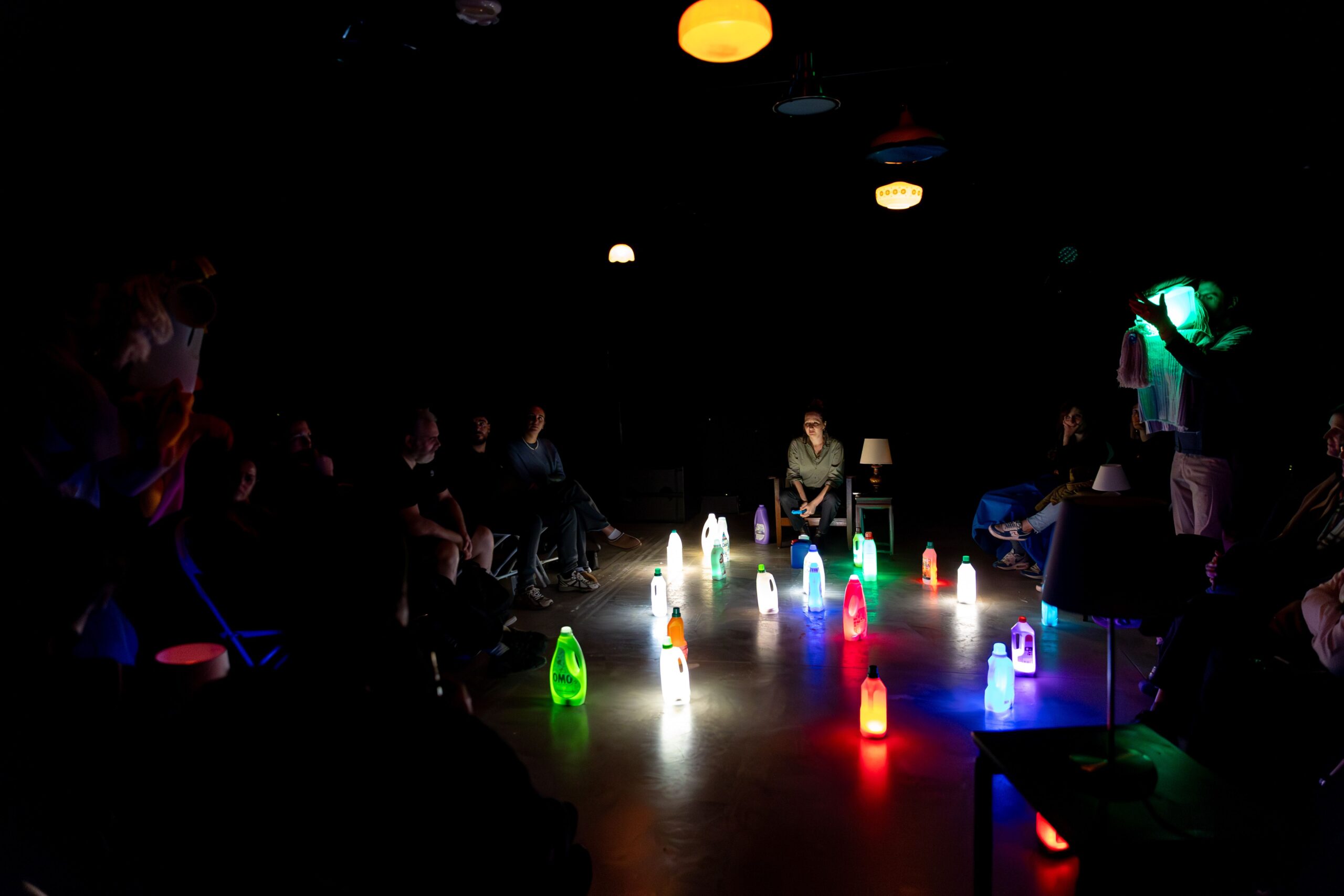
We’re at her place. “She” is Maryse – but we won’t learn that until much later. “She” is obviously dead, to judge by Loelia’s fright at discovering her absence. There are little bedside lamps here and there, lighting up as if by the magic of theater, to give a cozy halo to this drama. The only daughter, the eldest, enters first: Loelia . Then come her two brothers, Colin “the middle one” and Florian, “the last one”.
There’s a big green armchair where, one by one, they and she take turns to sit, to take her place, to try to understand who she was. But then, we can only understand what we can hear – that’s the principle of childhood. You can’t access the whole truth about your parents; you can only access what you can hear. So, now that it’s over, the trio can confront the real life of their mother, who was also a woman.
“We can only understand what we can hear”.
Like many women in the 20th century, she had to sacrifice her professional life to bring up her children, confronting jobs that were harder than the others: cleaning lady, work at the market… The floor was soon littered with cans of cleaning products, each more polluting than the last. She recounts, through the mouths of grown-up children, how the smells used to stick to her.
The play is at the crossroads of documentary theater and fiction. It features voice-overs: testimonies gathered from precarious and invisible workers. We enter into a true intimacy, that of desires, pains and sorrows – that of dreams that become nightmares by dint of not being lived.
Florian Pâque, Nicolas Schmitt and Loélia Salvador devour the stage, switching from their roles as children to those of characters from Maryse’s life. The staging is brimming with good ideas, sparking off light and bubbles, giving this sad story an almost fairy-tale feel.